A Drawer of Evidence: Curating Physical Samples for Calmer Client Briefings

There is a moment in many client conversations when words begin to circle. A paper is described as warm, a fabric as substantial, a finish as soft but not too soft. Everyone nods, and yet the decision remains slightly abstract. A small physical sample, placed on the table at the right moment, often settles the matter faster than another paragraph of explanation.
The sample drawer is not a showroom. It is a working collection: a modest, carefully edited archive of papers, boards, fabrics, finishes and offcuts that can be handled during briefings. For designers and makers working from rented London homes, where space is finite and a permanent display is neither practical nor desirable, it offers a discreet way to bring material evidence into the room.
Begin with the questions clients actually ask
A useful archive is built around recurring decisions rather than a desire to collect. Before adding anything, consider the questions that tend to arise: How heavy is this paper? Will this fabric mark? Does this finish show fingerprints? What is the difference between these two whites? Which of these can be delivered in a fortnight?
The drawer should be small enough to remain legible. For most sole practitioners, thirty to forty active samples is ample. These might include a handful of uncoated and coated papers, two or three board weights, a few fabric swatches, one or two surface finishes, and a small selection of relevant offcuts from past work. The point is not completeness. It is readiness.
Grouping by decision also helps. Rather than separating everything by supplier, keep a tray for paper and board, a wallet for textiles, and a small box for finishes and edges. A client does not need to understand the trade taxonomy. They need to compare like with like.
A drawer, not a display
In a rented flat, the archive should occupy a single shallow drawer, a lidded archive box, or one shelf of a cupboard. Conservation-grade or acid-free wallets are sensible for papers and textiles that will be handled repeatedly. Keep the collection out of direct sunlight and away from radiators. A neutral cotton cloth, folded in the drawer, can be laid out for viewings and returned afterwards.
Rotation matters. Samples that are beautiful but no longer representative should be retired, not kept out of sentiment. A quarterly review is usually enough. Check for fading, creasing, loose fibres and outdated supplier information. Replace anything that no longer does its job. The archive should feel current, not archival in the museum sense.
For client meetings, bring out only three to five items at a time. A crowded table invites indecision. A small, considered selection gives the conversation a shape. If the brief changes, return the unused samples to the drawer and begin again.
Labels that do the quiet work
A sample without a note is merely a scrap. The most useful labels are written in plain English and include information that answers practical questions without requiring a supplier call. On the front, give the material type and a short description. On the back, add the supplier, date acquired, cost band, lead time, and any care or suitability notes.
A label might read: “Uncoated cream paper, 120gsm. Warm white, slight tooth. Suitable for letterheads and menus; not for heavy ink coverage. Supplier: [name]. Acquired: March 2026. Lead time: stock.” Another might say: “Wool-blend upholstery swatch. Dense, matte. Marks easily with oils; best for low-contact areas. Similar to the fabric used on the [project] seating.”
Avoid relying on adjectives alone. “Luxurious” tells a client very little. “Soft to the touch, but prone to pilling under friction” tells them something they can use. Where a sample has been superseded, say so clearly. Where it resembles another option, note the difference. These small annotations reduce the chance of a confident nod turning into a later query.
The briefing ritual
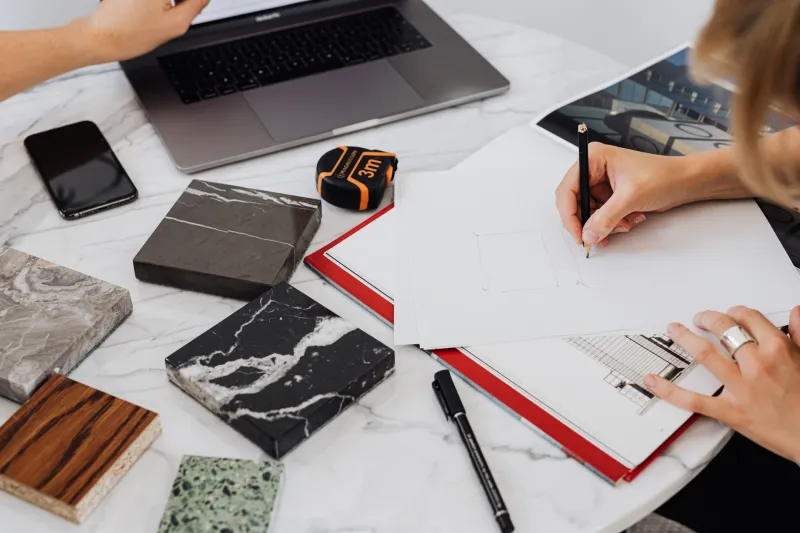
Before a meeting, select a shortlist from the drawer and lay it out on a neutral surface. Let the client handle the samples rather than simply looking at them. Touch is not a gimmick; it is a way of testing assumptions. A paper that looks calm on screen may feel too thin in the hand. A fabric that appears rich in a photograph may be warmer or heavier than expected.
As decisions are made, record them. A simple photograph of the chosen combination, with a note of the date and the client’s comments, is often more useful than a long recollection. Return the samples to their wallets afterwards. The ritual is modest, but it gives the conversation a beginning, a middle and a clear end.
Maintenance and discretion
The drawer should remain a private working tool. Client-facing samples from identifiable projects should be kept only with permission, and confidential work should not be left on display. The archive is there to support conversations, not to advertise. A plain label and a tidy wallet are usually enough.
Finally, keep the collection replenished. Whenever a new material is specified, order a small extra piece for the drawer. Whenever a supplier changes a specification, update the note. The effort is slight, but the return is considerable: fewer misunderstandings, calmer briefings and a client who leaves with a clearer sense of what they have chosen.
A sample drawer will not make a London flat larger. It will, however, make the work more tangible. In a profession built on decisions that are often made at a distance, that is a quietly useful thing to keep within reach.