A Fortnight on a Neighbour's Wall: Practical Notes on Borrowed Exhibition Space
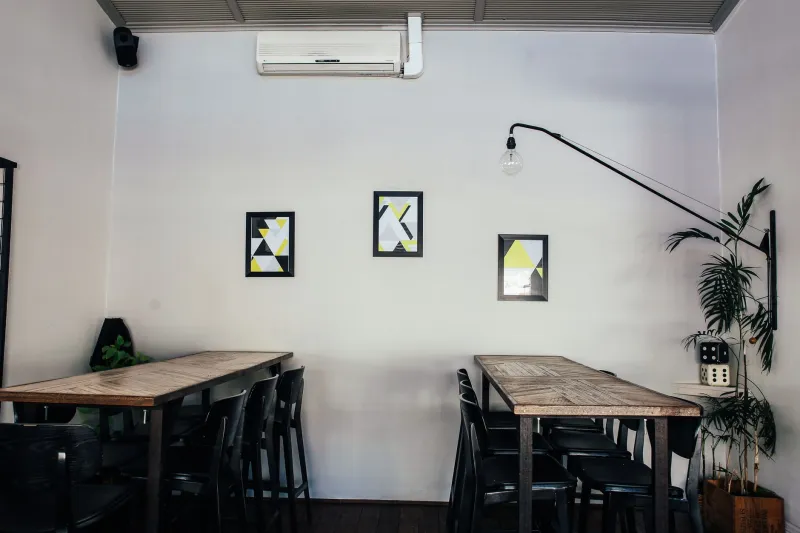
There is a particular kind of exhibition that never appears on a private view list. Six framed prints above the banquette of a neighbourhood café. Four small ceramics on a shelf in a florist. A run of photographs down the corridor of a community centre, past the noticeboard and the recycling bins. The work is shown for a fortnight, seen by people who are already thinking about something else, and then it comes home again.
Done carelessly, this is a nuisance for the host and a small humiliation for the maker. Done with a little discipline, it is one of the cheapest and most useful forms of exposure available to a designer or maker working at a modest scale. What follows is the method I have settled into after a handful of such arrangements, most of them in South and East London.
Begin with the room, not the work
The temptation is to decide what you want to show and then hunt for a wall. It is better the other way round. Sit in the café. Notice where people stand, where they queue, where the light falls at four in the afternoon, whether the wall behind the till is already crowded with chalkboards. A host will usually agree to a display in the one place you cannot use: a dim alcove, a corridor with fire exit signage, a stretch of wall directly behind a door.
Ask yourself honestly whether the space would show anything well. If the answer is no, wait for another room. There is no shortage of walls in a city; there is a shortage of good ones.
The approach: a short letter and a shorter ask
Approach in person first, at a quiet hour, and follow up by email so that there is a written thread. Keep the ask small and specific. Not would you consider exhibiting my work, which invites a vague refusal, but something closer to: I make small framed prints; I would like to hang five of them on the wall by the window for two weeks in March; there would be no cost to you and I would take them down myself on a Sunday morning.
Bring one piece with you, or a single printed sheet showing the work at actual size and in proportion to the wall. Bring a card with your name and a telephone number. Do not bring a portfolio.
Expect two questions. The first is about money, and the answer should be immediate and clear: either there is no commission and no fee, or there is a simple split, stated as a percentage, stated once. The second is about hassle, and the answer should be a timetable: when you will hang, when you will return to check, when you will take down, and how long the wall will be out of their hands.
Terms on one page
For anything longer than a weekend, put the arrangement in writing, even if it is only four paragraphs in an email that the host replies yes, that's fine to. The page should cover:
- the dates of the hang and the takedown, with times;
- exactly which wall or surface is being used, and what may not be touched;
- who is responsible for fixing, and what fixings are permitted;
- whether work may be sold, at what price, and who handles the transaction;
- who holds the keys, or who opens the door on the day;
- what happens if a piece is damaged, lost or stolen;
- the name and number of one person on each side.
Two clauses matter more than the rest. First, state plainly that the work remains your property and is not to be moved, lent or stored elsewhere. Second, agree that the host is not accepting liability for the work, and that you carry your own cover. A café owner who is asked to insure five hundred pounds of somebody else's prints will usually say no to the whole idea, and reasonably so.
Labels that answer questions before they are asked
A small card beside each piece, or one card for the group, should give the maker's name, the title, the medium and the price, or the words price on request if you would rather handle enquiries yourself. Add a line with a website and an email address. That line is the entire commercial point of the exercise.
Resist the long artist's statement. In a room where people are eating, three sentences is generous and one is often enough. Print on decent card, not paper, and fix the labels so they cannot walk. A small QR code is acceptable; a large one is a demand.
Fixing, securing and the matter of the wall
Never assume you may drill. Most hosts will not want holes, and some will not want adhesive on fresh paint. Ask what the wall is made of and what has been used there before. Removable adhesive strips are usually welcome on painted plasterboard; they are not reliable on brick, on dusty render, or in a warm window where the adhesive softens.
Where the wall is difficult, consider a different approach altogether: a shallow shelf, a small plinth, a folding screen you supply and remove. Work that stands is easier to secure than work that hangs.
Security is mostly a matter of sense. Small, desirable objects near a door are a risk; so is anything within easy reach of a pavement table. For pieces of real value, consider a discreet cable and padlock, or show reproductions and keep the originals at home. Never leave a piece of sentimental or irreplaceable work in a room you do not control overnight.
Photograph the wall before you hang and after you finish. Note any pre-existing marks. It takes four minutes and settles every later conversation about a scuff.
Insurance and the honest gaps
Check your own policy before you promise anything. Many household contents policies extend to property temporarily away from home, but the cover is often limited and sometimes excludes items on commercial premises. If you are trading, you may also need public liability cover, particularly if you are fixing anything above head height or leaving an object that could fall.
If cover is absent or unclear, say so to the host and adjust what you show. The honest version of the arrangement is usually this: the work is left at the owner's risk, the host takes reasonable care, and the maker accepts the residual risk in exchange for the space. Written down, that is unglamorous but perfectly workable. Left unspoken, it becomes a grievance.
The takedown is part of the show
Arrive when you said you would. Bring your own cloth, filler if permitted, and a bag for the fixings. Leave the wall cleaner than you found it. Send a short note of thanks within the week, and a photograph of the wall in use, which hosts often like to keep.
If anything sold, settle the commission promptly and in full, with a simple statement. If nothing sold, say so plainly in the thank-you note; it is a courtesy, and it prevents an awkward assumption.
Was it worth repeating?
Wait a fortnight before judging. Count the enquiries rather than the compliments, and note which pieces drew attention rather than which ones you like best. A display that produces two genuine conversations and one commission is a success at this scale, whatever the footfall.
Then ask the host directly whether they would have you back, and ask yourself whether the room suited the work. If both answers are yes, propose a second fortnight six months out, with different pieces. If either is no, leave it. A borrowed wall is a small kindness, and it should not be spent more than once on a room that does not serve the work.